
Loved by God.

- UBF Gospel Musings
- Chicago, IL, United States
- * Let go of control. * Trust God. Thank God. Think about God. Talk to God. Talk about God. * It's good to suffer loss. It draws me to the Cross where God's loss is more than what anyone ever lost. * We cannot hear what the stories of the Bible are saying until we hear them as stories about ourselves.
Tuesday, December 12, 2023
Day 9 of Advent reflection, 12/12/23: Hail Mary, Full of Grace (Luke 1:28)

Sunday, December 10, 2023
Day 8 of Advent, 12/10/23: The Gospel of the Son of God (Mk 1:1)
"The beginning of the good news (gospel) about Jesus the Messiah (Christ), the Son of God" (Mk 1:1).
What is the good news to me? Who is the King of my life? Confronting the Powers That Be by Bishop Barron.
We Christians are so familiar with the gospel/good news, such as John 3:16, without realizing the original context. When the apostles used the term evangelion, i.e. good news, it was typically used to describe a military victory by the Emperor, who sent out "evangelists" with this good news.
Also, "Son of God" was a title claimed by Caesar. But the apostles insisted that only Christ is the Son of God, the King of kings and the Lord of lords, which would be a direct challenge to the authority and the powers and principalities of the world.
The good news of the Son of God is the most subversive message, and not necessarily a feel good message that will be welcomed by many, especially by those in positions of power and privilege.
Saturday, December 9, 2023
Day 7 of Advent, 12/9/2023: The Laborers are Few (Mt 9:37)
"The harvest is plentiful but the workers are few. Ask the Lord of the harvest, therefore, to send out workers into his harvest field." (Mt 9:37-38).
- I pray that my life, lifestyle, choices, and morals may reflect Christ and the holiness of God (Rom 8:29; Heb 12:10).
- In my older years (Ps 92:14) I pray to live a life of repentance (Ps 51:1-4; Mk 1:15).
- I pray to learn and/or re-learn a life of prayer, piety and purity so that God can use me to somehow influence others (Ps 51:13), even the next generation (Ps 22:30).
First Week of Advent |
Matthew 9:35—10:1, 5a, 6–8 |
Friends, today Jesus instructs us to pray for laborers for the harvest, for disciples to do the work of evangelization. We need to organize our lives around evangelization. Everything we do ought to be related somehow to it. This doesn't mean that we all have to become professional evangelizers. Remember, you can evangelize by the moral quality of your life. But it does mean that nothing in our lives ought to be more important than announcing the victory of Jesus. |
Thursday, December 7, 2023
Day 6 of Advent, 12/8/23, Hail Mary, Full of Grace (Lk 1:26-38)

I'll start this Advent reflection with a prayer: I pray that Protestants and Catholics may love each other in Christ, rather than strongly denounce the other over differences.
"Greetings, you who are highly favored [Hail, full of grace]! The Lord is with you" (Lk 1:28). "I am the Lord's servant," Mary answered. "May your word to me be fulfilled" (Lk 1:38).
Day 5 of Advent, 12/07/23: The Storm Will Come (Mt 7:21-27)
"The rain came down, the streams rose, and the winds blew and beat against that house" (Mt 7:25, 27).
Matthew 7:21 is one of the scariest verses in the whole Bible. What is Jesus' criteria for knowing or not knowing us on the day of judgment? It is simply our response to the word of God.
The rain, floods and strong winds are what happens in life. These storms symbolize all the trials, testings, tribulations and temptations that everyone encounters--sooner or later. I did not notice this before but the storms of life do not discriminate: it comes regardless of whether or not you obey God's word (Mt 7:25, 27). The only difference is in the outcome. Those who obey God's word will not be hurt or harmed by the storm in the end, but those who do not obey will crash and burn.
Wednesday, December 6, 2023
Ps 8 Frail Humans Empowered to be Responsible (Psalm 8:1-9)
"Lord, our Lord, how majestic is your name in all the earth! You have set your glory in the heavens" (Ps 8:1). "...what is mankind that you are mindful of them, human beings that you care for them? You have made them a little lower than the angels and crowned them with glory and honor" (Ps 8:4-5).
Psalm 8 is the first experience of joyful praise and adoration, after 5 consecutive psalms (3-7) through the dark valleys of lament and pleas for deliverance. After this brief but brilliant chorus of praise, we will return again in the following psalms to the darkness of pain and the anguish of brokenness. But here is Psalm 8, if for just a moment, darkness and suffering are driven away by the commanding vision of the sovereign God of the created universe and his unfathomable care for humanity.
Psalm 8 may be considered a hymn of praise or a hymn of creation praise together with Psalms 33, 104 and 145 as "Songs of Creation."
- The sovereign Yahweh (Ps 8:1a, 9). The thematic framework. The central message of wondrous awe.
- Yahweh's rule (Ps 8:1b-2). The creative power of Yahweh. Praise of God's majestic power and protection of creation. The glory of the great King.
- Yahweh's condescension (Ps 8:3-5). Human frailty. Recognition of human frailty in light of God's creative power. The littleness of human beings. God's interest in humankind. Humankind's derived glory (Ps 8:5).
- Yahweh's ruler (Ps 8:6-8). Empowerment and responsibility. Acceptance of divine empowerment of humans and their resultant responsibility. The greatness of human beings. Humankind's glory as ruler.
Psalm 8 can be summarized as follows (Longman III):
- A Ascription of praise (Ps 8:1a).
- B The glory of the great King (Ps 8:1b-2).
- C God's interest in humankind (Ps 8:3-4).
- C' Humankind's derived glory (Ps 8:5).
- B' Humankind's glory as ruler (Ps 8:6-8).
- A' Concluding ascription of praise (Ps 8:9).
Consider:
- The gift of the divine nature (Exo 3:14; Mk 14:62).
- The implications of the creation of man in the divine image (Gen 1:26-27).
- The meaning of God's command to humans to rule over the earth (Gen 1:28).
Titles: Crown of creation (Ps 8:5). The jewel of creation. Wonderful care (Ps 8:4). How majestic is God's name (Ps 8:1, 9). Consider the heavens (Ps 8:3). The power of the powerless. The glory of the Creator and of humankind.
References:
- Tremper Longman III & David E Garland. 2008. The Glory of the Creator and of Humankind. The Glory of God's Creation; Dignity of the Ideal Human.
- Tim Keller. The Songs of Jesus. 2015. Psalm 8: Wonderful Care.
- Gerald Wilson. 2002. 1. Thematic framework (1a, 9). 2. The Creative Power of Yahweh (1b-2). 3. Human Frailty (3-4). 4. Empowerment and Responsibility (5-8).
- John Goldingay. 2013. Psalm 8: Thus far and no farther.
- Derek Kidner. 1973. 1975. Psalm 8: Crown of Creation. 1. The praise of his glory (Ps 8:1-2). 2. What is man? (3-8). 3. The praise of his glory (Ps 8:9).
- Alec Motyer. 2016. Psalm 8: The Power of the Powerless. A1. The Sovereign Yahweh (Ps 8:1). B1. Yahweh's rule (Ps 8:2). C. Yahweh's condescension (Ps 8:3-5). B2. Yahweh's ruler (6-8). A2. The Sovereign Yahweh (Ps 8:9).
- John Stott. What is a Human Being? 1. The littleness of human beings (Ps 8:3-4). 2. The greatness of human beings (Ps 8:5-8).
Day 4 of Advent, 12/06/23: Give Away What You Receive (Mt 15:36-37)

Tuesday, December 5, 2023
Day 3 of Advent, 12/05/23: The Mystery of the Trinity (Luke 10:21)

1st, the mystery of our Trinitarian God: God the Son, through God the Holy Spirit prays to and praises God the Father. How is the Trinity relevant and how does this relate to man and his life? My simplistic thought is that since we are created in God's image, we are also "Trinitarian." We have head, heart and hands, through which we have cognition, emotion and volition, and so we can think, feel and do things. Unless my Trinitarian self is in sync, I can never have peace and joy, i.e. shalom, a wholeness in the totality of my being. If what I want (heart) does not coincide with what I know (head) and do (hands), I will never have shalom--peace and joy. If I enjoy the world when I know I should enjoy God, his kingdom and his righteousness, I will not have shalom. Sorry for being technical and cerebral!
Monday, December 4, 2023
Day 2 of Advent, 12/4/23: Just Say the Word (Matthew 8:8)

Monday, November 27, 2023
I Know My Sin (Psalm 51)

Read Psalm 51 and 2 Samuel 11:1-12:13.
Sin will take me further than I want to go.
Sin will keep me longer than I want to stay.
Sin will cost me more than I want to pay.
Sin will keep me longer than I want to stay.
Sin will cost me more than I want to pay.
- Why do you think you sin (1 Jn 2:16; Eccl 6:7; 5:10)? Is sin a big deal?
- Can a man reveal your sin (Jn 16:8)?
- Do you commit adultery and murder like David? See Exo 20:13-14, 17; Dt 5:17-18, 21; Mt 5:21-22, 27-28; Prov 5:20; 6:24-25; Rom 7:15, 17, 18, 19, 23. Did David break any other commandments?
- What are 3 words in reference to God (Ps 51:1)? 3 verbs for cleansing and 3 nouns for sin (Ps 51:1-2)?
- What is the basis of David's plea (Exo 34:6-7; Mic 7:18)? Why (Eccl 7:20; Rom 3:23)?
- What is the difference between mercy and grace? Does he deserve mercy? Is mercy a license to sin?
- How did his sin affect him (Ps 51:3, 8, 12; 13:2; 38:2, 6)? Who is ultimately offended by his sin (Ps 51:4; Gen 39:7, 9)?
- How bad do you feel about your sin (Ps 51:17)?
Thursday, November 16, 2023
Ps 22 Forsaken (Psalm 22)

Wednesday, November 15, 2023
Do you have a "Why" for your Life?

Logotherapy is a meaning centered psychotherapy. It is driven not by power or pleasure, but by meaning. Viktor Frankl: Actualization is NOT the Goal. In the death camps, you have nothing to lose except your life.
The Perfect King (Psalm 72)

"Endow the king with your justice, O God, the royal son with your righteousness" (Ps 72:1).
- Royal righteousness (Ps 72:1-4). Imitating God: the world and its people set to rights.
- Endless reign (Ps 72:5-7). Endless abundance under the king.
- Boundless realm (Ps 72:8-11). World dominion.
- Compassionate king (Ps 72:12-14). The caring rule.
- Endless blessing (Ps 72:15-17).
- The nations respond in devotion (Ps 72:15).
- Shared abundance under the king (Ps 72:16-17).
- Doxology and conclusion (Ps 72:18-19). Reflecting God: the earth filled with his glory.
Tuesday, November 14, 2023
Ps 88 Faith Without Hope as the Darkness Deepens

- Can you live a life without comfort (1-9a)? Die without hope (9b-12)? Have questions without answers (13-18)?
Saturday, November 4, 2023


Thursday, November 2, 2023
What Hatred and Love Does to You by MLK
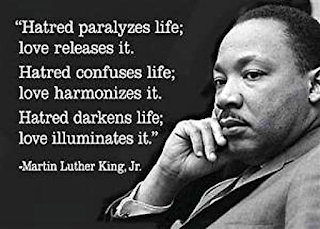
"Love is the greatest force in the universe. It is the heartbeat of the moral cosmos. He who loves is a participant in the being of God."
Wednesday, November 1, 2023


Saturday, October 28, 2023
Faith under Fire (Psalm 73)

A. Faith professed (Ps 73:1). God is good.
B. Faith questioned (Ps 73:2-14). The evil of envy.
C. Faith refocused (Ps 73:15-20). A new perspective.
B1. Faith unquestioned (Ps 73:21-26). Guided by God's counsel.
A1. Faith affirmed (Ps 73:27-28). God's closeness is good.
5 books of Psalms corresponding to the Torah:
- Book 1 (1-41). Genesis. Songs of relationship...with God.
- Book 2 (42-72). Exodus. Songs of redemption...delivernace by God.
- Book 3 (73-89). Leviticus. Songs of refuge. Sanctuary of God. [reflection]
- Book 4 (90-106). Numbers. Songs of repercussion. Rebellion...against God.
- Book 5 (107-150). Deuteronomy. Songs of revival. Renewal with God.
Tuesday, October 24, 2023

Repay Evil for Evil

"In the old days, people demanded 'an eye for an eye and a tooth for a tooth,' and to repay evil for evil. Patience was not yet on the earth, because faith was not on the earth either. Of course, impatience made full use of the opportunities the Law gave it. That was easy when the Lord and Master of patience was not here. But now that he has come and put the grace of faith together with patience, we are no longer allowed to attack someone even with a word—not even to call someone a fool without facing the danger of judgment. The Law found more than it lost when Christ said, 'Love your enemies and pray for those who persecute you, so that you may be sons of your Father who is in heaven' (Matthew 5:44-45). This most important commandment summarizes in a word the universal discipline of patience, since it does not allow us to do evil even to people who deserve it."—Tertullian

Tuesday, October 17, 2023
When Your World Falls Apart (Psalm 3-7)
When Life Takes a Turn for the Worst (Psalm 3-7)
- Psalm 3: Facing a New Day (Ps 3:5-6). You are not alone.
- Psalm 4: Facing Another Night (Ps 4:4; 6:6). Who can I turn to?
- Psalm 5: Starting a New Day (Ps 5:3). On pleading with the King.
- Psalm 6: Waiting is Hard (Ps 6:1-4). The way prayer makes a difference.
- Prayers and tears (Ps 6:6-9).
- Psalm 7: Sin and judgment. The judge is on your side.
- A Conscience without Offence (Ps 7:3-5).
- A cry for justice (Ps 7:6-11).
Sunday, October 15, 2023

Friday, October 13, 2023
Happiness (Psalm 1-2)

Ø Is there a key to happiness? Or is it a carefully guarded secret known only to a very few special select people?
Ø What do you think you need to be happy and to avoid unhappiness?
Monday, October 9, 2023
Wounds are Healed from the Heart, not the Head (Henri Nouwen)
Live Your Wounds. You have been wounded in many ways. The more you open yourself to being healed, the more you will discover how deep your wounds are.... The great challenge is living your wounds through instead of thinking them through. It is better to cry than to worry, better to feel your wounds deeply than to understand them, better to let them enter into your silence than to talk about them. The choice you face constantly is whether you are taking your hurts to your head or to your heart. In your head you can analyze them, find their causes and consequences, and coin words to speak and write about them. But no final healing is likely to come from that source. You need to let your wounds go down to your heart. Then you can live through them and discover that they will not destroy you. Your heart is greater than your wounds. |
Sunday, October 8, 2023

Friday, October 6, 2023
Imagine Yourself as a Living House (CS Lewis)
"Imagine yourself as a living house. God comes in to rebuild that house. At first, perhaps, you can understand what He is doing. He is getting the drains right and stopping the leaks in the roof and so on: you knew that those jobs needed doing and so you are not surprised. But presently he starts knocking the house about in a way that hurts abominably and does not seem to make sense. What on earth is He up to? The explanation is that He is building quite a different house from the one you thought of – throwing out a new wing here, putting on an extra floor there, running up towers, making courtyards. You thought you were going to be made into a decent little cottage but He is building a palace. He intends to come and live in it Himself."—C. S. Lewis
Thursday, September 28, 2023

Wednesday, September 27, 2023
When a Preacher is Downcast by Charles Spurgeon
"Even if the enemy's foot is on your neck, expect to rise and overthrow him. Cast the burden of the present, along with the sin of the past and the fear of the future, upon the Lord, who does not forsake His saints. Live by the day—ay, by the hour. Put no trust in frames and feelings. Care more for a grain of faith than a ton of excitement. Trust in God alone, and lean not on the needs of human help." Charles Spurgeon.
Who Is Your God? (Isaiah 40:1-11; 12-26; 27-31)
Who Is Your God? (Isaiah 40:1-11; 12-26; 27-31) [Nov 2016]
- The God of Comfort (1-11).
- The Incomparable God (12-26).
- The God Who Makes Man Fly (27-31).
Most scholars agree that ch. 40–55 were written to the Babylonian exiles after the destruction of Jerusalem in 586 B.C. (Some, doubt Isaiah wrote this ~150 years in advance, and say an anonymous prophet, a devotee of Isaiah, wrote it in 550 B.C. The book makes no reference to this.)
Theme:
- Chs.1-39 is Trust: the Basis of Servanthood.
- Chs. 40–55 is Grace: the Motive and Means for Servanthood, for trusting God.
- Ch. 40 is the intro;
- ch. 41–48 is part A, Motive;
- ch. 49– 55 is part B, Means.
- (40:1–2) What attitude/emotion requires encouragement? Why would the exiles be experiencing this? Why was God punishing them? What questions might they be asking? What encouragement does Isaiah offer here? How would these be encouraging? [Comfort" is not a good translation. The idea is to encourage, strengthen.]
- (40:3-5) How might 40:3 apply to John the Baptist (Mt 3:3; Mk 1:3; Lk 3:4)? How does that fulfill these promises? Compare to the promise of 7:14. What do these verses say about Yahweh's desire to deliver?
- (40:6–8) If the goal here is encouragement, how could 40:6–8 be understood as encouragement? Compare the final clause of 40:5 with the final clause of 40:8. What is the point of this repetition (Isa 45:23; 46:11b; 55:10-11)?
- (40:9-11) Zion and Judah have been destroyed (9). How can they be the heralds of deliverance (10)? What is the good news (11)? What are the two different uses of "arm"? How do they relate to the message of good news? See shepherd in the OT (Ps 23:1; 78:52; Jer 23:2-3; Eze 34:1-31; Mic 2:12). How does Jesus exemplify this (Jn 10:1-18)?
- (40:12–26) What is the expected answer to the rhetorical questions in 12–14? What is the point? [In the myths the gods were always taking counsel with one another to decide what to do (40:13–14).] Relate 40:15–17 to the points made in chs. 13–23.
- Why do people constantly seek out idols as objects of worship (18–20; 46:1–7)? How do they compare to Yahweh (21–24)? How is he different? How do 40:18-28 stress the uniqueness of Israel's God?
- Who is Yahweh being compared to (25–26)? [In paganism the stars are considered to be the visible representation of the gods. "The Host of Heaven" is an expression for "the gods."] What do 40:12–26 say about Yahweh's ability to deliver?
- (40:27–31) What are the people's complaint (27)? What are they forgetting (28)? Who gets tired (30)? Who gains strength (29)? How can any person "fly" (31)?
When Overcome by Sin and Guilt (Psalm 38)
 \
When You are Overcome by Your Sin and Guilt:
- How does David describe his suffering (Ps 38:1; 6:1)?
- Is he asking not to be rebuked or disciplined?
- Who does God discipline (Heb 12:6)? Why (Heb 12:10)?
- How does he feel (Ps 38:2)?
- What does David connect his suffering with (Ps 38:3, 5)? How did his sin and guilt affect him (Ps 38:4, 6-8)? How does your sin affect you?
- Does God discipline severely (Ac 5:5, 10; 1 Cor 11:29-30)?
- What kind of suffering have you experienced in your life?
- What do you think caused your suffering?
- What does David know about God's knowledge of him (Ps 38:9; 139:1, 5, 7, 23-24; Gen 16:13)? How is he different from Adam (Gen 3:10)? How devastated is he (Ps 38:10, 17)?
- How does David's friends react to him (Ps 38:11-12)? Why (Ps 38:16, 19-20)? How did he respond to their criticism and opposition (Ps 38:13-14; 46:10; Eccl 5:2; Isa 53:7; Mt 27:14)?
- After expressing great suffering what did David do (Ps 38:15; 39:7; 42:5, 11)? Is it easy for you to just wait on God without any time schedule (Job 13:15) What if you do (Isa 40:31)?
- Is it easy to honesty confess your sins (Ps 38:18)? What if you don't (Ps 32:3-4)? What if you do (Ps 32:5; 1 Jn 1:9)?
- Do you long to be near God more than with someone else (Ps 38:21)? How earnestly do you affirm your need for help (Ps 38:22)?
- Was his suffering relieved at the end of this Psalm? Is there a high point in this Psalm?
- How could David be so bold to appeal to God for mercy, being the guilty sinner that he was (Ps 51:3-4)?
- How might affliction, anguish, adversity and anxiety help a Christian more than comfort and convenience, safety and security (Ps 119:67, 71, 75, 92)?
- How does Psalm 38 point to Christ (Ps 22:1; Mt 27:46; Mk 15:34)?
Suscipe of St. Ignatius of Loyola

The Suscipe is a Catholic prayer written by St. Ignatius of Loyola. It is a surrender to God. It is in his Spiritual Exercises, 1st published in the 16th century. The prayer goes back to monastic profession and reciting Psalm 119. The prayer is:
- "Take, Lord, and receive all my liberty, my memory, my understanding, and my entire will, all I have and call my own".
- "You have given all to me. To you, Lord, I return it".
- "Everything is yours; do with it what you will".
- "Give me only your love and your grace".
Learn How to Suffer Well (Job 1:1-22)

* Learn from Job how to suffer well.
* Don't think that you did something wrong [even if you did] (Jn 9:1-3).
* Own your suffering (Job 1:20-21). Accept your situation/suffering.
* The ultimate value and purpose of our suffering (Rom 8:28-29).
* No need to know why except that God is good in all that he does.

Tuesday, September 26, 2023
Monday, September 25, 2023
Affliction, Adversity, Anxiety and Anguish is Good for Me (9/25/23)
- "Before I was afflicted I went astray, but now I obey your word" (Ps 119:67).
- "It was good for me to be afflicted so that I might learn your decrees" (Ps 119:71).
- "I know, Lord, that your laws are righteous, and that in faithfulness you have afflicted me" (Ps 119:75).
- "If your law had not been my delight, I would have perished in my affliction" (Ps 119:92).
- "My soul is in deep anguish. How long, Lord, how long?" (Ps 6:3).
- "My God, my God, why have you forsaken me? Why are you so far from saving me, so far from my cries of anguish?" (Ps 22:1).
- "Turn to me and be gracious to me, for I am lonely and afflicted. Relieve the troubles of my heart and free me from my anguish. Look on my affliction and my distress and take away all my sins" (Ps 25:16-18).
- "I will be glad and rejoice in your love, for you saw my affliction and knew the anguish of my soul." "My life is consumed by anguish and my years by groaning; my strength fails because of my affliction, and my bones grow weak" (Ps 31:7, 10).
- "I am feeble and utterly crushed; I groan in anguish of heart" (Ps 38:8).
- "My heart is in anguish within me; the terrors of death have fallen on me" (Ps 55:4).
- "Some became fools through their rebellious ways and suffered affliction because of their iniquities" (Ps 107:17).
- "The cords of death entangled me, the anguish of the grave came over me; I was overcome by distress and sorrow" (Ps 116:3).
- "If only my anguish could be weighed and all my misery be placed on the scales!" (Job 6:2).
- "Therefore I will not keep silent; I will speak out in the anguish of my spirit, I will complain in the bitterness of my soul" (Job 7:11).
- "Anxiety weighs down the heart, but a kind word cheers it up" (Prov 12:25).
- "A happy heart makes the face cheerful, but heartache crushes the spirit" (Prov 15:13).
- "Although the Lord gives you the bread of adversity and the water of affliction, your teachers will be hidden no more; with your own eyes you will see them" (Isa 30:20).
- "But what can I say? He has spoken to me, and he himself has done this. I will walk humbly all my years because of this anguish of my soul." "Surely it was for my benefit that I suffered such anguish. In your love you kept me from the pit of destruction; you have put all my sins behind your back" (Isa 38:15, 17).
- "See, I have refined you, though not as silver; I have tested you in the furnace of affliction" (Isa 48:10).
- "In the days of her affliction and wandering Jerusalem remembers all the treasures that were hers in days of old" (Lam 1:7a).
- "Look, Lord, on my affliction, for the enemy has triumphed" (Lam 1:9b).
- "I am the man who has seen affliction by the rod of the Lord's wrath" (Lam 3:1).
- "I remember my affliction and my wandering, the bitterness and the gall" (Lam 3:19).
- "For he does not willingly bring affliction or grief to anyone" (Lam 3:33).
- "Be joyful in hope, patient in affliction, faithful in prayer" (Rom 12:2).
Subscribe to:
Posts (Atom)