Loved by God.

My photo
Chicago, IL, United States
* Let go of control. * Trust God. Thank God. Think about God. Talk to God. Talk about God. * It's good to suffer loss. It draws me to the Cross where God's loss is more than what anyone ever lost. * We cannot hear what the stories of the Bible are saying until we hear them as stories about ourselves.
Showing posts with label heaven. Show all posts

Tuesday, September 8, 2026

Do Prostitutes Go to Heaven? (Matthew 21:28-32). Outline.

Jesus said to them, “Truly I tell you, the tax collectors and the prostitutes are entering the kingdom of heaven ahead of you” (Matthew 21:31b).
  1. The setting: To whom is Jesus speaking (Mt 21:23)? Why did they question his authority (Mt 21:9-10, 12-13, 15)? What prompted Jesus to tell them this parable [and the next 2] (Mt 21:24-27, 32, 38-39; 22:4, 5-6)? [These 3 parables are polemic parables.]
  2. Who does the father and the 2 sons represent (Mt 21:28a, 31, 32; Lk 15:1-2)?
    • What does this parable teach about the difference between words/promises, and actual obedience?

Tuesday, January 2, 2024

Heaven (Revelation 21:1-8)

“I am making everything new!” (Rev 21:5)
  • What is your idea of heaven? A pie in the sky? Playing harps on a cloud?
  • Do you fear death? Going to hell?

  1. What is significant about:
    • a new heaven and a new earth (Rev 21:1a; Isa 65:17; 66:22; 2 Pet 3:13),
    • the first heaven and the first earth (Rev 21:1b; 2 Pet 3:10) and 
    • no more sea (Rev 21:1c; 13:1; Dan 7:3; Isa 57:20; Lk 21:25)? Is this literal (Rev 21:6; 22:1-2, 17)?
  2. What is "the new Jerusalem" (Rev 21:2, 10, 16; Gal 4:26; Heb 12:22; cf. Exo 26:33-34; 1 Ki 6:20; 2 Chron 3:8)?
  3. Why is the promise of God dwelling with man the best promise ever (Rev 21:3-4, 7; 7:16-17; Eze 37:27; Is 25:8; 65:19; 9:6)? What prevents this from happening (Isa 59:2)?
  4. How does God make all things new (Rev 21:5; Isa 43:18-19, 2 Cor 5:17)?
  5. Why is God "the Alpha and the Omega" (Rev 21:6; 1:8; 22:13; Isa 41:4; 44:6; 48:12)? [What is Alpha and Omega in the Greek alphabet?] What is it to be thirsty for the water of life (Rev 21:6b; Isa 55:1; Jn 4:13-14)? To be victorious (Rev 21:7; Gal 3:26)?
  6. What is every person's worst destiny (Rev 21:8)? Are you afraid of dying? Hell? How can you not be cowardly (Rom 1:16; 2 Tim 1:7; Heb 2:14-15; Phil 1:21; Ac 20:24)?
  • How might the new heaven and the new earth be entirely and existentially different from anything you have ever experienced in your life? How can it help you handle trials, tribulations and temptations in your life?
Revelation is about the triumph of God over Satan and the forces of sin and evil through Christ, culminating in a new heaven and a new earth (Rev 21:1). The ultimate hope of God's people is heaven (> 500x in Scripture; ~50x in Revelation).

  1. Bonus questions for your own reflection and rumination:

  2. 1. What does the promise of a new heaven and a new earth signify to you?

    2. What emotions or thoughts does the description of the New Jerusalem evoke in you?

    3. How does the vision of God dwelling among His people influence your understanding of God's relationship with humanity?

    4. How does the absence of a physical temple in the New Jerusalem shape your view of worship?

    5. How does the concept of the second death in the lake of fire influence your understanding of divine judgment and reward?

    6. In what ways do you see God making things new in your life today?

    7. How can the promise of a life without mourning, crying, or pain bring comfort in your present situations?

    8. How can the detailed description of the New Jerusalem inspire you to live in anticipation of this glorious future?

    9. How can the vision of the New Jerusalem impact the way you handle trials and tribulations in your life?

    10. How does the vision of God as the Alpha and Omega influence your view of God's sovereignty?

    11. What does it mean to you to be called to "overcome," as mentioned in verse 7?

  • In what ways will the new heaven and the new earth be entirely different from anything we’ve experienced to this point in our lives? How will the new heaven and the new earth be better from what we’ve experienced to this point in our lives? (v. 1-8)
  • What does it mean to you that the Lord will dwell with us forever? Why is this important? (v. 3)
  • Why do you think John includes this beautiful, comforting picture of God wiping away every tear from our eyes? Why is this important? (v. 4) 
  • God prepares us for eternity and provides us with the perspective we need by means of His Word. How can you be more intentional about the time you spend in God’s Word moving forward? Alone? With your family? At church?
  • ● What do you think it means to live with an eternal perspective? Are you living with an eternal perspective? Moving forward, how can you more intentionally live in light of the eternal destiny that’s in store for you as God’s people?

Friday, December 15, 2023

Praise the Lord (Psalm 146-150)

  1. Praise the Creator who reigns forever (Ps 146:10): What does the psalmist boldly and proudly declare about praising God (Ps 146:1-2)? About not doing (Ps 146:3)? Why (Ps 146:4, 5-9, 10)?
  2. Praise the Creator who blesses His people with His Word (Ps 147:19): Notice the 3 calls to praise God (Ps 147:1, 7, 12). Why is it fitting to praise God (Ps 147:1)? What do these verses reveal about God (Ps 147:2-6, 8-11, 13-20a)? About his word (Ps 147:15, 18, 19; 33:6; Isa 55:9-11; Jn 6:63; 8:31-32)?
  3. Praise the Creator who alone is exalted (Ps 148:13): Who is called to praise the Lord in Ps 48:1-6 and Ps 48:7-12? What is the rational for doing so (Ps 148:13-14)? Who/What is "a horn" (Ps 148:14)?
  4. Praise the King who delights in His people (Ps 149:4): Who is called to praise God (Ps 149:1-3) and why (Ps 149:4-5)? Why must praising God with their mouths also involve "a double edged sword in their hands" (Ps 149:6, 7-9; Eph 6:17)?
  5. Let everyone, everywhere praise God in every way: Where do you praise God (Ps 150:1)? Why (Ps 150:2)? How (Ps 150:3-5)? Who should praise God (Ps 150:6)?
146:1-10 I will praise God as long as I live (Ps 146:2).
147:1-20 It is good to praise God (Ps 147:1).
148:1-14 Praise God from the heavens and the earth (Ps 148:1, 7).
149:1-9 Sing to God a new song (Ps 149:1).
150:1-6 Praise God in heaven and on earth (Ps 150:1, 6).

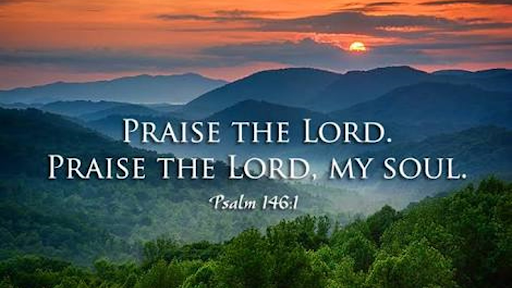
"Praise the
 Lord. Praise the Lord, my soul. I will praise the Lord all my life; I will sing praise to my God as long as I live. Do not put your trust in princes, in human beings, who cannot save" (Ps 146:1-3).

Psalms 146-150 constitute the last Hallel ("praise" [175 x in Psalms) collection, that are all praise and joy. These 5 joyous psalms of praise, each beginning and ending with Hallelujah, bring the Psalter to a close. So in this respect as in many others, the Psalms are a miniature of our story as a whole, which will end in unbroken blessing and delight. It may take a long time or a lifetime, but all prayer that engages God and the world as they truly are will eventually end in praise.

These psalms are used as daily prayers at some point in the synagogue's services of worship. The other 2 praise collections are the Egyptian Hallel psalms (113-118) and the Great Hallel (120-136).

Psalm 146 praises God because he guarantees justice. He cares for the poor, hungry, prisoner, physically impaired, soul weary, immigrant and single parent (Ps 146:7-9). He cared so much he became a helpless baby born to poor parents. 
  1. Tim Keller. The Songs of Jesus. 2015. Psalm 146: Praise for Justice.
  2. Kidner. 1973. 1975. Psalm 146: I'll praise my Maker (Ps 146:2). A lifetime of praise (Ps 146:1,2). Man, the false hope (Ps 146:3,4). God, great and good (Ps 146:5-9). An eternity of praise (Ps 146:10).
  3. Motyer. 2016. Merited Praise. 1. Life-long praise (Ps 146:1-2). 2. Why not man? (Ps 146:3-4). 3. Why Yahweh (Ps 146:5-9). Endless praise (Ps 146:10).
  4. Tremper Longman III & David E Garland. Psalms. 2008. Psalm 146: The Lord Reigns for Ever and Ever (Ps 146:10).

Saturday, August 4, 2012

What Is Heaven Like? (Revelation 21-22)

"He who was seated on the throne said, 'I am making everything new!' Then he said, 'Write this down, for these words are trustworthy and true.'”

Everything new. Every human being needs to experience newness of life. If not, we become like Cain, a restless wanderer (Gen 4:12-14). Mick Jagger sang, "I Can't Get No Satisfaction." No matter what we do or don't do, we feel restless without any lasting satisfaction. That's why God gives us promise after promise of:
  • a new heart and a new spirit (Eze 36:26),
  • being new (2 Cor 5:17),
  • renewal (Mt 19:28),
  • refreshment (Acts 3:19),
  • transformation (2 Cor 3:18), etc.
Our renewal and complete transformation (glorification) will happen at the end of the ages when Jesus returns, and we see him face to face (Rev 22:4). We see this best in the last 2 chapters of the Bible in Revelation 21-22.

Heaven. Revelation is about the triumph of God over the forces of evil through Jesus' victory over Satan culminating in a new heaven and a new earth (Rev 21:1). The ultimate triumph and hope of God's people is heaven referred to > 500 times in Scripture; Revelation about 50 times. What is heaven like? The last 2 chapters of the Bible gives what may be the best description, though deeply symbol laden with imagery derived from the OT (though the OT is not directly quoted). Think of heaven in 3 ways:
  1. What is New (Rev 21:1-8).
  2. What is Missing (Rev 21:9-27; 22:1-5).
  3. What is Ultimate (Rev 22:4-5).
I. What Is New (Rev 21:1-8)


  • A new heaven and a new earth (Rev 21:1; Gen 1:1).
    • Because of sin, our world is cursed (Gen 3:14-19). The 1st heaven and the 1st earth, the old order was "subjected to frustration" (Rom 8:20), "in bondage to decay" (Rom 8:21) and "groaning as in the pains of childbirth" (Rom 8:22).
    • Isa 65:17-19 - “See, I will create new heavens and a new earth. The former things will not be remembered, nor will they come to mind. But be glad and rejoice forever in what I will create, for I will create Jerusalem to be a delight and its people a joy. I will rejoice over Jerusalem and take delight in my people; the sound of weeping and of crying will be heard in it no more."
    • Isa 66:22 - “'As the new heavens and the new earth that I make will endure before me,' declares the Lord, 'so will your name and descendants endure'"
    • 2 Pet 3:13 - "But in keeping with his promise we are looking forward to a new heaven and a new earth, where righteousness dwells."
  • The Holy City, the new Jerusalem (Rev 21:2a, 10-11) is the church redeemed by Christ. She will no longer be trampled by the nations. She is a cube city, like the Most Holy Place in the OT sanctuary (1 Ki 6:20; Eze 41:4). 12,000 stadia, or 1,500 miles, or 2,200 km (Rev 21:15-17), a city of pure gold (Rev 21:18,21). The brilliance of the new Jerusalem is like the most precious costly stones (Rev 21:11, 19-21).
  • Consummation: Union of Christ with his people
    1. A beautiful bride (Rev 21:2b), the wife of the Lamb (Rev 21:9). Through Jesus' atoning death, God regards His redeemed people as his lovely and precious bride. Isa 62:5: "As a young man marries a young woman, so will your Builder marry you; as a bridegroom rejoices over his bride, so will your God rejoice over you."
    2. God dwelling with men (Rev 21:3,7). The greatest blessing of heaven will be unhindered fellowship with God. The goal of God’s covenant, “God with us” (Isa 7:14; Mt 1:23), foreshadowed in the OT tabernacle and temple, will be achieved. Gen 17:7-8: "I will establish my covenant as an everlasting covenant between me and you and your descendants after you for the generations to come, to be your God and the God of your descendants after you. The whole land of Canaan, where you now reside as a foreigner, I will give as an everlasting possession to you and your descendants after you; and I will be their God.” Lev 26:11-12: "I will put my dwelling place among you, and I will not abhor you. I will walk among you and be your God, and you will be my people." Jer 31:33: "'This is the covenant I will make with the people of Israel after that time,' declares the Lord. 'I will put my law in their minds and write it on their hearts. I will be their God, and they will be my people.'"
    3. Thirst quenched (5-6) from the water of life (Rev 22:1-3, 17). The "spring of the water of life" is the throne of God and the Lamb (Rev 22:1), a throne of grace (Heb 4:16) because here the thirsty drink without payment, by God’s free gift (Isa 55:1). This recalls Eden before the fall (Gen 2:8-10), and Ezekiel’s vision of a future glorious temple (Ez 47:1-12; Zech 14:8). Isa 49:10, 55:1: "Come, all you who are thirsty, come to the waters; and you who have no money, come, buy and eat! Come, buy wine and milk without money and without cost." Jn 6:35: "Then Jesus declared, 'I am the bread of life. Whoever comes to me will never go hungry, and whoever believes in me will never be thirsty.'"
    4. The ungodly banished (Rev 21:8, 22:11,15). Those who renounce faith do so because of cowardice or compromise with idolatry or sensuality. "Believers" fall away when their faith is challenged by hardship or difficulty. 1 Cor 6:9-10: "Or do you not know that wrongdoers will not inherit the kingdom of God? Do not be deceived: Neither the sexually immoral nor idolaters nor adulterers nor men who have sex with men nor thieves nor the greedy nor drunkards nor slanderers nor swindlers will inherit the kingdom of God." There is no evidence in the Bible (or in life) that there is ever any change of heart of those in hell (Rev 22:11; Lk 16:19-31).

II. What Is Absent/Missing (Rev 21:9-27; 22:1-5)
  • No sea (Rev 21:1c). This refers to the source of earthly rebellion, chaos, and danger—the sea from which the beast emerged (Rev 13:1; Dan 7:3). This symbolic (or literal) source of rebellion will no longer threaten creation’s perfection. Isa 57:20: "But the wicked are like the tossing sea, which cannot rest, whose waves cast up mire and mud. 'There is no peace,' says my God, 'for the wicked.'”
  • No tears (Rev 7:17; Isa 65:19), no death (Isa 25:8), no mourning, no crying, no pain (Rev 21:4).
  • No temple (Rev 21:22). Jesus himself is the tent and the temple in which God lives among his people (Jn 1:14; 2:19-21).
  • No sun and moon (Rev 21:23).
  • No impurity (Rev 21:27).
  • No curse (Rev 22:3).
  • No night (Rev 22:5).

III. What Is Ultimate (Rev 22:4-5): Seeing God’s face
  • When Moses asked to see God's face, God said, “you cannot see my face, for no one may see me and live” (Exo 33:20).
We long to see loved ones whom we miss after they die. Or as we die we remember our most cherished and beloved ones. As with many men, I love the ultra violent movie 300 where 300 Spartans stood their ground against an unending multitude of Persian troops. As the King of Sparta died in a hail of arrows, he said, "My queen, my wife, my love." It is a moving and romantic scene. But it is bittersweet because of the final parting of lovers through death. So it is with Romeo and Juliet. We human beings all long for a satisfaction through a love that knows no end.

On that day those who have persevered in faith will be fulfilled. It is our dearest and deepest longing to see God face to face, and to see Him look upon us with eyes of deep love and affection. It will be the greatest blessing of the age to come, as God looks upon his people with favor and delight. This is free and without cost to us. But it was not without cost to God. To look upon us God would have to look away from His Son on the cross though he cried out in agony of soul (Mt 27:46; Mk 15:34; Ps 22:1). God had to forsake his Son, so that he will not forsake us. God would "hate" his Son on the cross, so that He could love us. God forsook his Son so that He could usher in for us a new heaven and a new earth, which will be forever.
References:
  1. Carson, D.A. The God Who Is There: Finding Your Place in God's Story. Grand Rapids, Michigan: Baker, 2010, 213-224. (Video, 2009. Home At Last: The Spectacular God at Center, 2012)
  2. Morris, Leon, The Book of Revelation: An Introduction and Commentary (Tyndale New Testament Commentaries). Downers Grove: Inter-Varsity Press, 1987, 235-250.
  3. MacArthur, John. Revelation: Because The Time Is Near (MacArthur Bible Studies). Chicago: Moody Publishers, 2007, 313-328.
  4. ESV Study Bible (http://esvstudybible.org/).

Saturday, July 16, 2011

The Stairway to Heaven (Gen 28:10-22)

Gen28
"This is the gate of heaven" (Gen 28:17).

"Most people think of religion as man's quest for God. The God of the Bible, however, is the God who seeks us." Edmond Clowney, Preaching Christ in all of Scripture, 80.

"Jesus does not give recipes that show the way to God as other teachers of religion do. He is Himself the way." Karl Barth

One of my favorite songs of all time is "The Stairway to Heaven" by Led Zeppelin (1971). I could listen to it every day without ever getting tired of it. It is the perfect rock song. Why? The progressive crescendo and the spell binding ambiance makes the song mesmerizing. A google search says, "this song is about a woman who accumulates money, but finds out the hard way that her life had no meaning and will not get her into heaven."

Perhaps, this song has captivated countless millions of people of all ages through out the world for 40 years, because we human beings are all, without exception, seeking a "stairway to heaven," however we chose, on our own terms, to define heaven or God. In today's text, Jacob discovers, through his dream given to him by God, something radical about the stairway to heaven. It is the polar opposite of what most people and most religions think. Even Christians who misunderstand this "stairway to heaven" live a religious life that is not Christian, and which is no different from all other religions in the world.